Most people find out about high blood pressure by chance. It shows up at a routine check, before a small surgery, or after a relative has a heart attack. There is rarely any warning, and that is exactly why it is so dangerous.
One question we often hear from patients is: can homeopathy help bring my BP down?
This guide gives you an honest answer in simple words. You will also learn what the numbers mean, how to check your BP properly at home, what to eat, and when high blood pressure becomes an emergency.
Can Homeopathy Treat High Blood Pressure?
Homeopathy can be used as supportive care next to your doctor’s treatment, but it should never replace the blood pressure medicines your doctor has prescribed. A few small pilot studies from India report benefits in early (stage 1) high blood pressure, but larger and stronger trials are still needed. What is proven to lower blood pressure is less salt, regular activity, a healthy weight, no tobacco, limited alcohol, regular checks and, when needed, medicines.
Key points to remember:
- High blood pressure means the pressure in your blood vessels stays at 140/90 mmHg or higher on repeated readings.
- Most people feel nothing. Only a BP check can tell you.
- Never stop BP medicines on your own, even if your readings look normal.
- Try to keep salt below 5 grams a day, which is about one teaspoon.
- Aim for at least 150 minutes of moderate activity every week.
What Is High Blood Pressure?
High blood pressure, also called hypertension, means the force of blood pushing against your artery walls is too high for too long. WHO defines it as a pressure of 140/90 mmHg or higher.
Think of a garden hose. If the water pressure is always very high, the hose wears out faster. In the same way, high pressure slowly strains your blood vessels, heart, kidneys, brain and eyes, as the NHS explains.
Blood pressure is written as two numbers, such as 120/80:
- The top number (systolic) is the pressure when your heart beats.
- The bottom number (diastolic) is the pressure when your heart rests between beats.
Both are measured in mmHg (millimetres of mercury). If either number stays high, your blood pressure is high.
Blood Pressure Chart: What Is Normal and What Is High?
A normal blood pressure is below 120/80 mmHg. The table below follows the American Heart Association (AHA) categories.
| Category | Top number (systolic) | Bottom number (diastolic) | What it means |
| Normal | Below 120 | and below 80 | Keep up healthy habits |
| Elevated | 120 to 129 | and below 80 | Act early with lifestyle changes |
| Stage 1 high BP | 130 to 139 | or 80 to 89 | Doctor advises lifestyle changes, and sometimes medicine |
| Stage 2 high BP | 140 or higher | or 90 or higher | Doctor usually advises medicine plus lifestyle changes |
| Severe high BP | Above 180 | and/or above 120 | Contact your doctor at once. It is an emergency if you have symptoms |
Two points to keep in mind:
- Guidelines draw the line in slightly different places. The AHA calls 130/80 stage 1 high BP. WHO and the NHS use 140/90 to diagnose high blood pressure.
- One high reading is not a diagnosis. WHO says hypertension is confirmed when readings on two different days are 140/90 or higher. Only a doctor can confirm it.
High Blood Pressure in India: The Numbers
High blood pressure is very common in India, and many people do not know they have it. The ICMR-INDIAB study, published in The Lancet Diabetes & Endocrinology in 2023, surveyed 113,043 adults in every state. According to the South First report on the study:
- 35.5% of adults had high blood pressure.
- When the stricter American (ACC/AHA) cut-off was used, the figure rose to 66.3%.
- Every southern state was above 30%. Puducherry was highest at 51.8% and Jharkhand lowest at 11.6%.
The global picture is similar. WHO estimates that 1.4 billion adults aged 30 to 79 had hypertension in 2024. About 44% of them did not know they had it, and only about 23% had it under control.
The lesson is simple. A BP check takes two minutes, and it can save you from a stroke or a heart attack.
Symptoms of High Blood Pressure
Most people with high blood pressure feel completely normal. Both WHO and the NHS say that it usually has no symptoms, and that checking your BP is the only way to know.
Sometimes, mostly when the pressure is very high, people notice:
- Headaches
- Blurred vision
- Chest pain
When blood pressure reaches 180/120 or higher, WHO lists more warning signs: severe headache, dizziness, difficulty breathing, nausea, vomiting, anxiety, confusion, buzzing in the ears, nosebleeds and an abnormal heartbeat. If you have these with a very high reading, seek care straight away.
Please do not use a headache as your BP test. Many people with dangerous readings have no headache at all, and many headaches have nothing to do with blood pressure.
Causes and Risk Factors
For most people, high blood pressure builds up slowly from a mix of age, family history and daily habits. WHO and the NHS list these risk factors:
- Too much salt. A high-salt diet is one of the biggest causes you can change.
- Extra weight and little activity. Being overweight and sitting for long hours both raise BP.
- Alcohol and tobacco. Drinking too much alcohol and smoking both add to the risk.
- Unhealthy fats and few fruits and vegetables. WHO links diets high in saturated and trans fats, and low in fruit and vegetables, to higher BP.
- Long-term stress. The NHS lists long periods of stress as a risk. See our post on stress.
- Family history and age. BP tends to rise as we get older, and it runs in families.
- South Asian background. The NHS says people with South Asian roots have a higher risk.
- Other health problems. Diabetes and kidney disease raise the risk. Our posts on diabetes, cholesterol and thyroid health cover related conditions.
- Air pollution. WHO calls air pollution the most significant environmental risk factor for hypertension. This matters for people living in Delhi-NCR.
Most of these are in your hands. Salt, weight, activity, alcohol and tobacco are the five levers you can pull today.
How Is High Blood Pressure Diagnosed and Checked at Home?
Doctors confirm high blood pressure by measuring it more than once, because one reading can be a false alarm. WHO says hypertension is diagnosed when readings on two different days are both 140/90 or higher. The NHS adds two more details:
- High blood pressure is usually 140/90 or higher at a clinic, and 135/85 or higher at home.
- Your doctor may ask you to use a home monitor for a few days, or to wear a portable monitor for 24 hours.
How to check your BP at home
The American Heart Association gives these steps:
- Use the right device. Choose an automatic monitor with an upper-arm cuff. Wrist and finger monitors are less reliable.
- Check the cuff size. A cuff that does not fit gives wrong numbers. Take your monitor to your doctor once to confirm it matches the clinic machine.
- Prepare. Do not smoke, drink tea or coffee, or exercise for 30 minutes before. Empty your bladder.
- Rest and sit properly. Sit quietly for 5 minutes, back supported, with your arm resting at heart level. Do not talk.
- Take two readings, one minute apart. Do this at the same time each day, and write the numbers down.
- Bring your log to the doctor. A week of readings tells far more than one.
WHO says most people should aim for a BP below 140/90. If you also have diabetes, heart disease or kidney disease, the goal is usually below 130/80. Your doctor will set the right target for you.
How Does Homeopathy Approach High Blood Pressure?
Homeopathy looks at the whole person, not just the number on the BP machine. In classical homeopathy, the doctor takes a detailed case history. This covers your BP readings, family history, food and salt habits, sleep, work stress, emotional health and other illnesses. Treatment is then chosen for you as an individual.
In high blood pressure, the aim is to support your overall health and help you stick to the lifestyle changes that matter, while you continue your regular care. It is not meant to push you away from your doctor or your BP checks.
What does the research say?
The evidence is early and limited. A few small pilot trials from India have looked at individualised homeopathy in stage 1 hypertension. One trial run under the Central Council for Research in Homoeopathy followed 217 patients for three months. It reported better results for homeopathy plus lifestyle changes than for placebo plus lifestyle changes. The authors themselves say that further trials in a rigorous setting are needed. Note that everyone in these trials also got lifestyle advice.
On the other side, in 2015 Australia’s National Health and Medical Research Council reviewed 225 studies and concluded that there is no reliable evidence that homeopathy works for any health condition. Homeopathy researchers have criticised that review.
What does this mean for you? Treat homeopathy as an add-on at most. Keep your BP checks, your diet changes and any medicine your doctor has prescribed.
What Homeopathy Cannot Do for High Blood Pressure
Homeopathy cannot replace the blood pressure medicines your doctor has prescribed. The NHS says a doctor will usually prescribe medicine if your BP is very high, if you are at higher risk of a heart attack or stroke, or if it stays high after lifestyle changes. Please keep these points in mind:
- Do not stop or reduce your BP medicines on your own. The AHA warns against this whatever your home readings show. Normal readings often mean the treatment is working.
- It cannot handle an emergency. A reading above 180/120 with chest pain, trouble breathing, weakness or vision change needs a hospital, not a home remedy.
- Do not rely on one reading. Check your BP the right way, record it, and share the log with your doctor.
- Do not try salt substitutes without asking. Many contain potassium, which can be harmful for people with kidney problems or on certain medicines.
- Do not trust “quick cure” claims. High blood pressure is a long-term condition that needs steady care.
- Do not skip check-ups. Regular BP, kidney, sugar and cholesterol tests keep you safe.
NHMRC gave a similar warning in its homeopathy review: people who choose homeopathy may put their health at risk if they reject or delay treatment that has good evidence behind it.
Diet Tips for High Blood Pressure: Cut Salt, Add Potassium
The single most useful diet change for blood pressure is eating less salt. WHO recommends less than 5 grams of salt a day for adults, which is just under one teaspoon. The world average is about 11 grams, more than double that.
Salt hides in more places than the salt shaker. WHO says a lot of it comes from processed foods, snacks, breads and sauces. In Indian homes, the usual suspects are:
| Cut down on | Easy swaps |
| Pickles (achar), papad and chutney from jars | Fresh chutney made with little or no salt, lemon, or a squeeze of lime |
| Namkeen, bhujia, chips and other packaged snacks | Roasted chana, fresh fruit, unsalted nuts |
| Instant noodles, packet soups and ready meals | Home-cooked dal, sabzi and roti |
| Ketchup, sauces and salad dressings | Herbs, spices, curd and lemon for flavour |
| Extra salt sprinkled on salad, raita or fruit | Taking the salt shaker off the table |
A few more tips from WHO:
- Cook with little or no added salt, and use herbs and spices for taste.
- Read food labels. One gram of salt equals about 400 mg of sodium, so 5 grams of salt equals 2,000 mg of sodium.
- Limit foods high in saturated and trans fats, and eat more fruits and vegetables.
Potassium helps too
The AHA explains that potassium reduces the effect of sodium and eases tension in blood vessel walls. Good food sources include bananas, spinach and other greens, tomatoes, oranges, peas, potatoes, dates and low-fat milk or curd.
One caution: too much potassium can be harmful if you have kidney disease or take certain medicines. Ask your doctor before using potassium supplements or salt substitutes.
The ICMR-NIN Dietary Guidelines for Indians also advise limiting salt and ultra-processed foods. For diabetes-friendly eating, see our guide on homeopathic treatment for diabetes.
Lifestyle Habits That Lower Blood Pressure
Lifestyle changes help every person with high blood pressure, and some people can manage with them alone in the early stage. WHO says that many people who make these changes will still need medicine, so think of them as the base of your plan.
- Move more. WHO advises at least 150 minutes a week of moderate activity, such as brisk walking, cycling, swimming or dancing, or 75 minutes of vigorous activity. Add strength exercises on two or more days, and try to sit less.
- Reach a healthy weight. If you are overweight, losing weight lowers BP. Our post on weight and metabolism may help.
- Quit tobacco. Every form of tobacco, including beedi and gutka, harms blood vessels.
- Keep alcohol low. WHO says no more than 1 drink a day for women and 2 for men. The NHS advises staying under 14 units a week.
- Do not overdo caffeine. The NHS lists coffee, tea and cola as drinks to keep in check.
- Manage stress. WHO and the NHS both link long-term stress to high BP. Short walks, deep breathing and a regular routine can help. See our guide on stress.
- Watch the air. WHO calls air pollution the biggest environmental risk factor for hypertension. On very polluted days in Delhi-NCR, consider exercising indoors.
Pick one habit to start this week, and add another next month. Steady change beats a big plan that you drop in ten days.
Complications and When It Becomes an Emergency
If high blood pressure is not controlled, it damages the body slowly and quietly. WHO says it can cause chest pain, heart attack, heart failure, an irregular heartbeat, stroke and kidney failure. The NHS also lists vascular dementia. The good news is that even a small drop in BP lowers these risks.
Here is what to do in different situations. The reading limits come from the AHA.
| Situation | What to do |
| One slightly high reading at home | Rest, check again after a minute, and record both. Share your log with your doctor |
| Often have headaches or blurred vision | See your doctor soon for a BP check |
| Reading above 180/120 and no other symptoms | Wait one minute and check again. If it is still very high, contact your doctor right away |
| Reading above 180/120 with chest pain, shortness of breath, back pain, numbness, weakness, vision change or trouble speaking | Emergency. Go to a hospital now. In India, call 112 |
| Sudden chest pain that does not go away, or pain spreading to the arm, neck or jaw, with sweating or nausea | Emergency. It could be a heart attack. Call 112 and do not drive yourself |
Do not wait to see if the pressure comes down on its own in an emergency.
What to Expect in a Homeopathy Consultation for High Blood Pressure
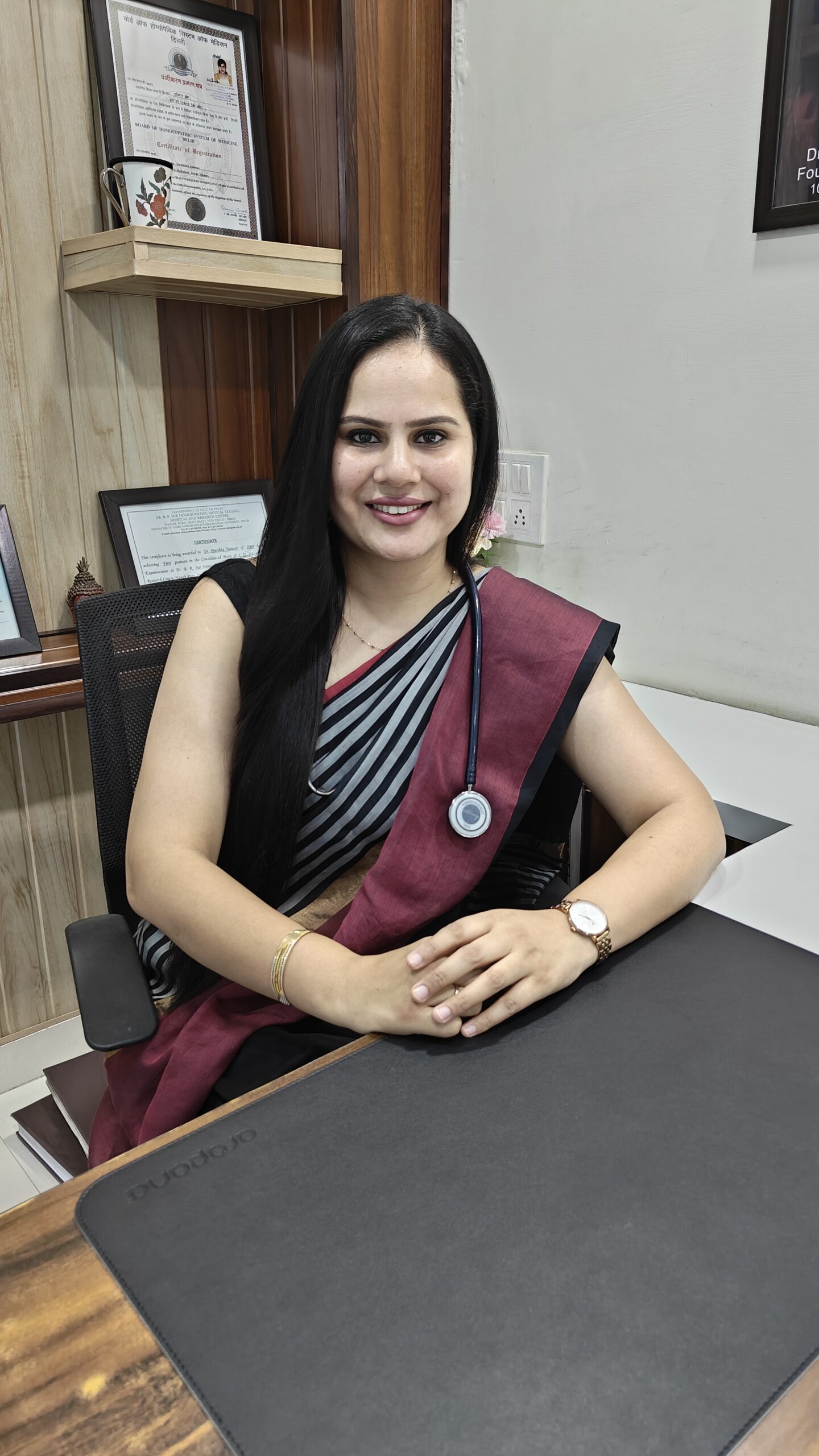
A good consultation starts with listening. At Pratibha Homeopathic Clinic in Tagore Garden, New Delhi, Dr. Pratibha Tanwar follows the classical homeopathic approach, which looks at the patient as a whole and tries to work on the root cause, not only the symptom.
Here is how you can prepare:
- Bring your BP log. A week of home readings, with dates and times, is more useful than one number.
- List every medicine you take. Include BP tablets, vitamins and any herbal products.
- Carry your reports. Recent kidney, sugar and cholesterol tests help the doctor see the full picture.
- Be ready to talk. Expect questions about your salt habits, sleep, work stress, family history and daily routine.
- Ask what to expect. Ask what homeopathy can and cannot do for your case, and when your progress will be reviewed.
- Keep your regular doctor informed. Share your homeopathic plan with them, and theirs with us.
Dr. Pratibha Tanwar is a gold medalist BHMS doctor and sees patients at the clinic and online. You can book a visit or take an online consultation from anywhere.
Frequently Asked Questions
Can high blood pressure be treated by homeopathic treatment?
No. High blood pressure is a long-term condition that is controlled, not cured. Homeopathy may be used as supportive care alongside your doctor’s plan. Salt control, activity, weight control and prescribed medicines remain the base of treatment.
Can I stop my BP medicines if I take homeopathy?
No. Never stop, reduce or change your BP medicines on your own. Stopping suddenly can push your pressure up and raise your risk of a heart attack or stroke. Any change must come from the doctor who prescribed them.
What is a normal blood pressure?
A normal blood pressure is below 120/80 mmHg, according to the AHA. A reading of 140/90 or higher on repeated checks is considered high blood pressure by WHO and the NHS. Readings in between need attention and lifestyle changes.
What are the symptoms of high blood pressure?
Most people have no symptoms at all. Some notice headaches, blurred vision or chest pain, usually when the pressure is very high. Because of this, regular BP checks are the only reliable way to find out.
How can I lower my blood pressure naturally?
Eat less than 5 grams of salt a day, be active for at least 150 minutes a week, reach a healthy weight, avoid tobacco and keep alcohol low. WHO says these steps help every person with hypertension, though many people will still need medicine.
How much salt should I eat in a day?
WHO advises less than 5 grams of salt a day for adults, which is just under one teaspoon. This includes the salt in pickles, snacks, bread, sauces and packaged food, not only the salt you add at the table.
How should I check my BP at home?
Use an automatic upper-arm monitor. Rest for five minutes, sit with your arm at heart level, and avoid tea, coffee, smoking and exercise for 30 minutes before. Take two readings a minute apart at the same time each day, and write them down.
When is a high BP reading an emergency?
A reading above 180/120 is an emergency if you also have chest pain, shortness of breath, back pain, numbness, weakness, vision change or trouble speaking. Go to a hospital immediately and call 112 in India. Do not wait for it to settle on its own.
Final Thoughts
High blood pressure rarely hurts, which is why it is easy to ignore. But the tools that work are simple and well known: check your BP, cut the salt, move every day, keep a healthy weight, avoid tobacco, and take the medicines your doctor prescribes.
Homeopathy can have a place as supportive care, as long as it sits beside this plan and not in place of it. Be careful with anyone who promises a quick cure.
If you want to talk through your case, Dr. Pratibha Tanwar sees patients at her clinic in Tagore Garden, New Delhi, and online. Book your appointment or call +91-7827525956. Please carry your BP log, your latest reports and a list of your medicines.
About the Author
Dr. Pratibha Tanwar, BHMS (Gold Medalist) is a homeopathic doctor in Delhi. She completed her BHMS with honours in 2010 from Dr. B. R. Sur Homoeopathic Medical College, Hospital and Research Centre, New Delhi, and served there as a house physician for one year. She also completed the SCPH specialty course in Predictive Homoeopathy from ICHM. Her clinic lists skin, hair, diabetes and other chronic conditions among her areas of work. Read more on the About the Doctor page.
Medical Disclaimer
This article is for education only. It is not a diagnosis or a substitute for advice from your own doctor. Do not stop or change any blood pressure medicine without talking to the doctor who prescribed it. If you think you have a medical emergency, go to the nearest hospital or call 112. See our full Medical Disclaimer and Editorial Policy.
Sources
- WHO: Hypertension fact sheet (25 September 2025)
- WHO: Sodium reduction fact sheet (11 May 2026)
- NHS: High blood pressure
- American Heart Association: Understanding blood pressure readings
- American Heart Association: Home blood pressure monitoring
- American Heart Association: How potassium can help control high blood pressure
- ICMR-INDIAB study, The Lancet Diabetes & Endocrinology, 2023 and South First report on the study
- ICMR-NIN Dietary Guidelines for Indians 2024, South First report
- Individualised homeopathy in stage 1 hypertension, CCRH trial abstract, Homeopathy journal, 2020
- NHMRC 2015 homeopathy review, CBC News report and Homeopathy Research Institute analysis of the review