You first notice it as a dry, red patch on your elbow or knee. Then the skin starts to flake, and it itches. Someone at home says it is a fungal infection. Someone else says it is “just dryness”. You try a few creams, and the patch comes back every time.
For many people in Delhi and across India, this is how psoriasis begins. It is a common skin condition, and it is often misunderstood. People worry that it spreads by touch, or that they did something wrong. Neither is true.
This guide explains psoriasis in plain words: what it is, what sets it off, what doctors can do, and where homeopathy fits in honestly.
Quick Answer: Can Homeopathy Treat Psoriasis?
Homeopathy may be used as supportive care alongside proper skin treatment, but there is no strong scientific proof that it clears psoriasis. Psoriasis is a long-term condition with no known cure. What helps most is understanding your triggers, caring for your skin every day, and seeing a skin specialist when the condition is moderate or severe.
Key points to remember:
- Psoriasis is a long-term skin disease linked to the immune system. It is not contagious.
- It comes in cycles. There are flare-ups, and then calmer periods.
- Stress, infections, skin injuries, smoking and some medicines can trigger a flare.
- It can also affect nails and joints, so do not ignore nail changes or joint pain.
- Never stop a prescribed skin treatment on your own because you started homeopathy.
What Is Psoriasis, Really?
Psoriasis is a skin disease that causes itchy, scaly patches, most often on the knees, elbows, trunk and scalp. The Mayo Clinic describes it as a common, long-term condition with no cure.
Here is what happens inside the skin. Normally, your skin makes new cells and sheds old ones slowly. In psoriasis, the immune system sends mixed signals, and skin cells grow much faster than usual. The old cells pile up on the surface as thick, dry, silvery scales.
Think of it like a traffic jam. New cells keep arriving, but the old ones have not left yet. The result is a raised, red patch covered with scale.
Five Things People Get Wrong About Psoriasis
- “It is contagious.” No. You cannot catch psoriasis from touching, hugging or sharing a towel.
- “It is a hygiene problem.” No. It comes from the immune system and genes, not from dirt.
- “It is just dry skin.” Dry skin improves with moisturiser alone. Psoriasis patches keep coming back and need a proper plan.
- “It only affects the skin.” It can also involve nails and joints, and some people feel tired and low during flares.
- “A quick cure is possible.” Be careful with anyone who promises to remove psoriasis for good in a few weeks. No treatment can promise that.
Types of Psoriasis
Not all psoriasis looks the same. Knowing the type helps your doctor choose the right care.
| Type | Where it shows up | What it looks like |
|---|---|---|
| Plaque (most common) | Elbows, knees, lower back, scalp | Dry, raised red patches covered with scales |
| Guttate | Trunk, arms, legs | Small, drop-shaped spots, more common in children and young adults |
| Inverse | Skin folds: groin, under the breasts, buttocks | Smooth, red, inflamed patches that worsen with sweat and rubbing |
| Pustular (rare) | Palms and soles, or widespread | Pus-filled blisters on red skin |
| Erythrodermic (rare) | Whole body | Peeling, intensely itchy or burning rash. This needs urgent medical care |
What Triggers a Flare-Up?
Many people carry the tendency for psoriasis for years without any patches. Then something sets it off. The Mayo Clinic lists these common triggers:
- Infections, such as a throat infection or skin infection
- Skin injury, like a cut, burn, insect bite or even a bad scratch
- Stress, which is one of the most commonly reported triggers
- Smoking and heavy alcohol use
- Certain medicines. Always tell every doctor about all your medicines
- Severe sunburn and very cold, dry weather
A simple tip: keep a trigger diary for a month. Write down your stress level, sleep, food, weather and any new product you used. Patterns often show up. Your doctor can use this diary too.
Family history also matters. Psoriasis runs in families, and having a parent with it raises your chances. Stress is a big theme at our clinic, so you may also find our guide on stress useful.
Psoriasis Is More Than a Skin Problem
Watch for these signs, because they need a doctor’s attention:
- Nail changes: tiny pits, thickening, colour change, or nails lifting from the nail bed
- Joint pain and stiffness, especially in the morning. This can be psoriatic arthritis, which causes pain, stiffness and swelling in and around the joints
- Scalp scaling that looks like heavy dandruff. Our post on dandruff explains how to tell the difference
- Low mood or embarrassment about the way the skin looks. This is real, and it is fine to talk about it
How Is Psoriasis Diagnosed?
Most of the time, a doctor can diagnose psoriasis by looking at your skin, nails and scalp and asking about your family history. Sometimes a small skin sample (a biopsy) is taken to rule out other conditions. Psoriasis can look like eczema or a fungal infection, so please do not self-diagnose. Using the wrong cream can make things worse.
How Does Homeopathy Approach Psoriasis?
Homeopathy looks at the whole person, not only the patches. In classical homeopathy, the doctor takes a detailed case history: when the patches began, what makes them better or worse, your sleep, stress, digestion, family history and your emotional state. Care is planned for you as an individual, so two people with psoriasis may get different advice.
For psoriasis, the aim of homeopathic care is to support your overall health and help you cope better with flares, alongside the care your skin doctor gives you.
What does the research say? The honest answer is that the evidence is limited. A large 2015 review by Australia’s NHMRC found no reliable evidence that homeopathy works for any health condition. Homeopathy researchers have criticised that review, but studies on psoriasis specifically are few and small. We explain this in more detail in our post on homeopathic treatment for diabetes. So please treat homeopathy as an add-on, not a replacement.
What Homeopathy Cannot Do for Psoriasis
- It cannot promise a permanent cure. No treatment can.
- It should not replace the treatment your skin specialist has prescribed. Do not stop or reduce any prescribed treatment on your own.
- It cannot manage emergencies such as a whole-body peeling rash, high fever with skin changes, or pus-filled blisters spreading quickly.
- It cannot treat psoriatic arthritis in place of a rheumatologist, because untreated joint disease can cause lasting damage.
Daily Skin Care That Actually Helps
Good daily habits make a real difference, whatever else you are using.
- Moisturise after every bath. Apply a plain, fragrance-free moisturiser while the skin is still slightly damp.
- Use lukewarm water, not hot, and keep baths short.
- Do not pick or scrub the scales. Skin injury can trigger new patches in the same spot.
- Wear soft cotton and avoid tight clothes over affected areas, especially in skin folds.
- Be careful with sun. Short, sensible sun exposure helps some people, but sunburn can trigger a flare. Ask your doctor what is safe for you.
- Patch-test any new product on a small area before using it widely.
Food and Lifestyle: What We Know and What We Do Not
No single food cures psoriasis. But some habits are worth keeping because they help your health overall.
- Quit smoking and limit alcohol. Both are linked to more inflammation and worse symptoms in some people.
- Keep a healthy weight. Extra weight can make symptoms worse. Our guide on weight and metabolism may help.
- Eat simple, home-cooked food with vegetables, dal, whole grains and less sugar and fried snacks.
- Sleep and manage stress. A fixed bedtime, a daily walk and a few minutes of slow breathing can reduce stress for many people.
- Notice your own pattern. If a certain food clearly worsens your skin every time, note it in your diary and tell your doctor.
When to See a Doctor Without Delay
| What you notice | What to do |
|---|---|
| Patches are spreading fast or covering a large area | See a skin specialist soon |
| Painful, stiff or swollen joints, or changes in the nails | See your doctor soon. This can be psoriatic arthritis |
| Skin is cracked, bleeding, oozing or very painful | Get it checked, because infection is possible |
| Red, peeling rash across most of the body, with fever or feeling very unwell | Emergency. Go to a hospital now. In India, call 112 |
| Pus-filled blisters appearing quickly, with fever | Emergency. Go to a hospital now |
What to Expect in a Homeopathy Consultation for Psoriasis
At Pratibha Homeopathic Clinic in Tagore Garden, New Delhi, Dr. Pratibha Tanwar follows the classical approach, which looks at the patient as a whole. Here is how to prepare:
- Bring your reports and old prescriptions, including any skin specialist’s notes.
- Carry a list of every cream, tablet and supplement you use.
- Bring your trigger diary, or at least a rough idea of when flares happen.
- Take clear photos of your skin during a flare, so the doctor can see the pattern.
- Ask what homeopathy can and cannot do for your case, and when you should review progress.
Frequently Asked Questions
Can homeopathy cure psoriasis?
No. There is no known cure for psoriasis, and there is no strong evidence that homeopathy cures it. Homeopathy can be used as supportive care next to your skin doctor’s plan, but it should not replace it.
Is psoriasis contagious?
No. You cannot catch psoriasis from another person. It does not spread by touch, sharing food, swimming or using the same towel.
What triggers psoriasis flare-ups?
Common triggers include stress, infections, skin injuries, smoking, heavy alcohol use, severe sunburn and some medicines. Triggers differ from person to person, so a trigger diary can help you find yours.
Is psoriasis the same as eczema?
No. They can look similar, but they are different conditions. Psoriasis usually causes thick, well-defined scaly patches on elbows, knees and scalp, while eczema is often itchier and more common in skin folds. A doctor should confirm which one you have.
Can psoriasis affect the nails and joints?
Yes. Psoriasis can cause pitting, thickening or lifting of the nails. Some people also develop psoriatic arthritis, with joint pain, stiffness and swelling. If you notice joint symptoms, see a doctor early.
Does stress make psoriasis worse?
For many people, yes. Stress is one of the most commonly reported triggers. Regular sleep, daily movement and calming habits can help, but they do not replace medical care.
Is psoriasis hereditary?
It tends to run in families. Having a parent with psoriasis raises your risk, and having two parents with it raises the risk further. Many people with a family history never develop it, so genes are only part of the story.
Final Thoughts
Psoriasis is a long-term condition, but it can be managed. The basics work best: know your type, find your triggers, care for your skin every day, and see a skin specialist when it is more than mild.
Homeopathy can have a place as supportive care, as long as it sits beside proper treatment and not in place of it. If you would like to talk through your case, Dr. Pratibha Tanwar sees patients at her clinic in Tagore Garden, New Delhi, and online. Book your appointment, join an online consultation, or call +91-7827525956.
About the Author
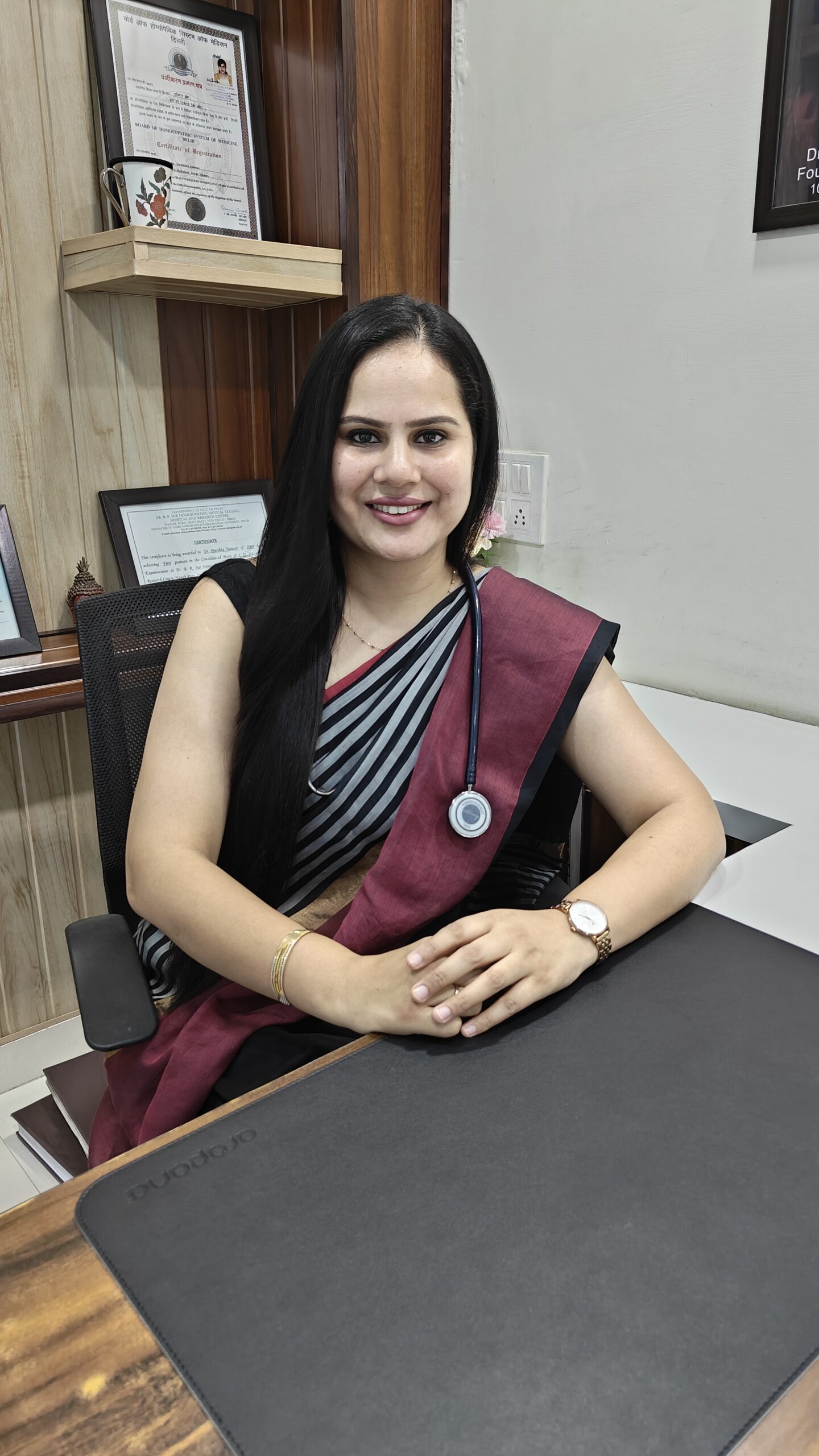
Dr. Pratibha Tanwar, BHMS Gold Medalist is a homeopathic doctor in Delhi. She completed her BHMS with honours in 2010 from Dr. B. R. Sur Homoeopathic Medical College, Hospital and Research Centre, New Delhi, and served there as a house physician for one year. She also completed the SCPH specialty course in Predictive Homoeopathy from ICHM. Her clinic lists skin, hair, diabetes and other chronic conditions among her areas of work. Read more on the About the Doctor page.
Medical Disclaimer
This article is for education only. It is not a diagnosis or a substitute for advice from your own doctor. Do not stop or change any prescribed treatment without talking to your doctor. If you have a widespread peeling rash, fever or feel very unwell, go to the nearest hospital or call 112. See our full Medical Disclaimer and Editorial Policy.
Sources
- Mayo Clinic: Psoriasis, symptoms and causes
- Pfizer Health Answers: About psoriasis
- NHMRC 2015 review of homeopathy, discussed in our diabetes guide